Does AI mention your business? Start with a repeatable check
Your business did not appear in a ChatGPT answer. Before changing the website, I recommend checking what was asked and what came back. This guide explains how to record the check, repeat it and choose what needs attention.
TL;DR
- Choose customer questions and save the exact prompts, complete answers, and test conditions.
- Distinguish a company mention from a website link and a product recommendation.
- Repeat the check over time. Your sample is not market share, and a mention does not establish an inquiry.
Test record: On 13 October 2026, Codex (AI) checked the example against the 24 records collected on 11 October, including denominators and overlap calculations. No new answers or business results were collected.
A measured example: 24 answers, two different observations
The Hebrew and English pilot collected two answers to each of six questions in each language on 11 October 2026: 6 × 2 × 2 = 24 Perplexity answers. Each category had a preselected tracked brand that was not named in the prompt. These are six different companies, not 24 checks of Nir Levi or of a single business.
| Observation | Panel result | Calculation | Supported interpretation |
|---|---|---|---|
| Mention of the category’s tracked brand | 24 of 24 | 24 / 24 = 100% | Each brand appeared in all answers for its category |
| Link to that brand’s official domain | 22 of 24 | 22 / 24 ≈ 91.7% | Two exports lacked an official-domain link |
| Recommendation or product-claim accuracy | Not scored | No calculated percentage | Neither follows from a mention |
The difference between the first two rows matters. The first English privileged-access answer listed CyberArk, but linked to its document at static.carahsoft.com. That is a brand mention without an official-domain link in the export. A single “present / absent” field would lose the distinction.
The same record lets you compare source sets. For each pair, the study divided shared hostnames by all distinct hostnames across both answers. The mean across 12 Hebrew–English pairs was 34.7%. Same-language repeats averaged 47.2%, so simply repeating a question also changed the sources. Language cannot be assigned as the sole cause.
I would use this record to choose a specific investigation: open the external source, identify the information it supplies and compare it with our product page. Keep the original prompt for the next repeat. Rewording it or adding the brand may support a different investigation, but cannot establish improvement on the same check.
The 24 observations as CSV · Answers, prompts and calculations. Collection and calculations used Codex assistance. This is a small, one-day, single-engine panel, not market share or a client result.
Start with a customer decision
Choose one product or service and one audience. Write five questions that audience might ask before getting in touch: questions about solutions, fit, alternatives, costs, and drawbacks. Start with questions that do not name your business. Keep branded questions in a separate group.
For illustration, a project-management software company could ask “Which tools suit a team of ten?” That requests product suggestions. “How should we choose a tool?” may produce advice without product names. Interpret each answer in the context of its question.
Record what actually appeared
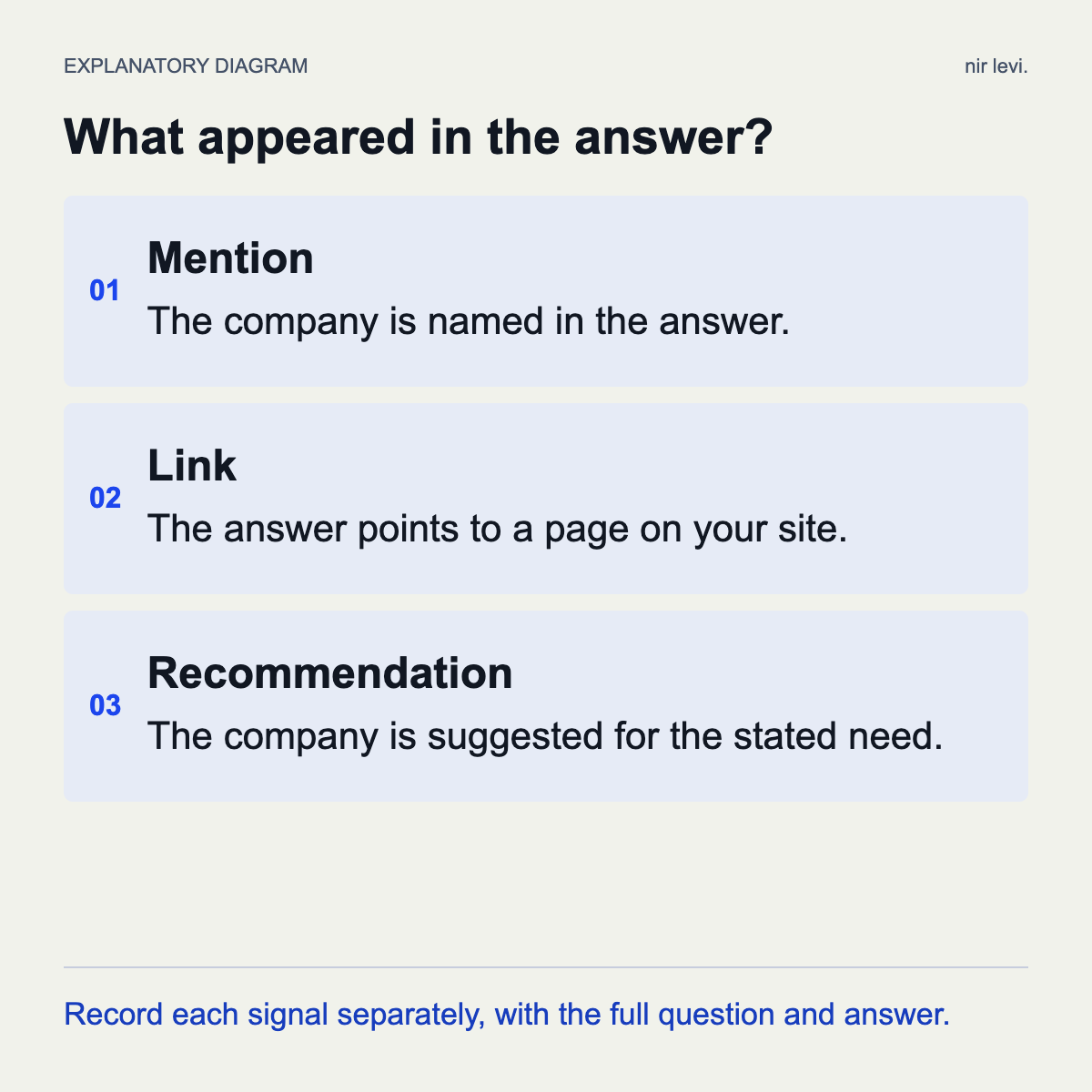
For each check, save the tool, date, language, exact question, answer, and source links. Record whether web search was enabled when that information is visible. Distinguish three observations:
- Mention: your company is named in the answer.
- Citation or link: the answer points to a page on your website.
- Recommendation: your company is presented as a suitable option for the need being tested.
Repeat before drawing conclusions
You might run a weekly check, keeping questions and conditions as consistent as possible. Save answers that do not include your company too. Flag changes in wording, tool, or language so you can interpret differences later.
If your company appeared in three of ten answers, report exactly that. Do not label it ‘30% of the market.’ Look at actual visits and inquiries alongside your answer records. A mention does not establish that a customer arrived.
Turn an observation into a website task
Look for a specific gap: outdated product details, missing suitability information, or a page that makes the answer difficult to find. Address one gap and record the date of the change. Compare the next set of answers without assuming your edit caused every difference.
Google says its existing SEO foundations apply to AI Overviews and AI Mode. No special schema or new AI file is required. A supporting page needs to be indexed and eligible for a snippet, and inclusion is still not guaranteed. This guidance concerns Google’s search products.
Google Search Central: AI features and your website ↗Sources & further reading
Sources checked on
How this article was created
- AI involvement
- AI-assisted drafting
- Recorded tools
- Codex
- Last substantive update
- Translation
- AI-assisted translation
Put the method into practice: choose questions and collect answers with the AI visibility checker ↗
Open the AI visibility worksheet