
A question inventory
Category questions, solution comparisons and branded questions. Define the audience, language and platform for each group within the agreed scope.
Published research on this site · 11 October 2026
GEO and AEO consulting with Nir Levi for companies in Israel: AI visibility reviews, source analysis, and practical content and technical plans in Hebrew and English.
More about my approach: AI visibility and sources and questions and answers on your pages.
Start with your website and what you want to investigate. We’ll agree on the languages, platforms, scope and price before any work begins.
To understand how your company appears in AI answers, I start with questions your customers might ask. We’ll examine what the answers say, which sources they use and what needs improving on your site. You’ll receive content and development recommendations supported by the findings.
Choose systems around your audience and its questions. Google AI Overviews, ChatGPT Search and Perplexity are starting points to assess; Gemini, Copilot and Claude join the scope where they matter to a buying decision. Platform coverage is agreed before work begins.
| Platform | What we examine |
|---|---|
| Google AI Overviews / AI Mode | Answers and supporting links in Google Search’s AI experiences. Record the query, language and experience observed. These are distinct from the Gemini app. Google’s guidance ↗ |
| ChatGPT Search | How search-enabled answers describe the brand, which pages they link to and whether the facts are correct. Check OAI-SearchBot access separately from the policy for model training. OpenAI’s guidance ↗ |
| Perplexity | Which sources support an answer, whether the site is linked and whether product statements are accurate. Record a citation separately from a visit or brand recommendation. Perplexity’s crawler documentation ↗ |
| Google Gemini | Answers and sources in the selected mode and language. A Gemini answer is not assumed to represent what appears in AI Overviews. |
| Microsoft Copilot / Bing | The answer experience included in the scope and available citation data in Bing Webmaster Tools. Identify the product and data source being assessed. |
| Claude by Anthropic | Where buyers use it for research or comparison, examine web-search answers and linked sources. Record whether web search was enabled. |
The site’s checker covers ChatGPT and Gemini. Reviewing additional platforms through the consulting service is scoped separately. Open the AI visibility checker ↗
Category questions, solution comparisons and branded questions. Define the audience, language and platform for each group within the agreed scope.
Record the question, system, search mode, date and collected answer. Keep brand mentions, linked citations, recommendations and factual accuracy separate.
Examine cited sources, missing or inconsistent information and access to relevant pages. Each finding includes its supporting evidence and what still needs investigation.
Tasks with affected pages, a rationale, a responsible role and a way to verify the change. Implementation support and repeat checks are agreed in the scope.
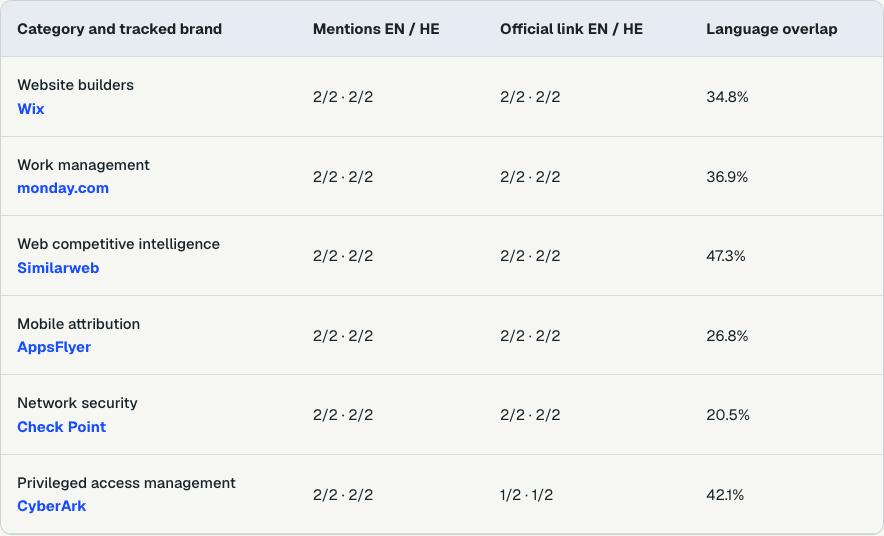
The pilot collected 24 Perplexity answers to six buying questions in Hebrew and English. Each tracked category brand appeared in every answer for that category, while average cross-language source-host overlap was 34.7%. This record separates brand presence from the sources accompanying the answer.
Your review starts with questions relevant to your buyers, retains the answers and identifies website checks. This panel is not a client result or a measure of the whole market.
Read the research, questions and full data ↗Agree on the questions, languages, systems and data before starting. Price and timing depend on the scope. The result is a set of inspectable findings and a plan your team can act on.
Select audiences, questions and systems. Agree on what needs to be understood and the data and read-only access required.
Save the question, tool, search mode, language, date and answer. Define repeated checks to see whether an observation recurs.
Examine cited sources, consistent brand facts and gaps in relevant pages. Check whether access restrictions prevent content collection.
Define tasks, responsible roles and verification criteria. Implementation support and repeat checks follow the agreed scope.
Check crawl access, internal links and important information in visible text. Schema.org supplies the vocabulary for describing the person, business and service; JSON-LD is Google’s recommended structured-data format. The markup should match what readers see.
Google’s structured-data guidance ↗Google does not require a special AI schema or AI text file for AI Overviews or AI Mode. Missing business information and inaccessible pages take priority before expanding the content.
Google’s requirements for AI features ↗Imagine a comparison answer describes an outdated product feature. Here is how that observation could become a task. This example is fictional; an actual review includes the saved answer and source.
Open the evidence worksheetA mention, citation, recommendation, visit and inquiry are different outcomes. Retain the questions and test conditions, examine repeated observations and compare each measure separately. One changed answer does not establish a lasting improvement.
| Question | Evidence and its limits |
|---|---|
| Is the brand present and described correctly? | An agreed question sample and saved answers. Separate mentions, recommendations and accuracy; record system, language and repeats. This is a sample, not a measurement of every AI answer. |
| Is the website cited? | Links saved with answers and Bing Webmaster Tools AI Performance data where access and data are available. Citation Share is not traffic share or proof that a site change caused a citation. |
| Can Google discover the pages? | Google Search Console for indexing and performance. AI Overviews and AI Mode traffic is included in overall Web reporting; it is not a separate AI citation report. |
| Are visits and inquiries resulting? | Available referral and UTM data in Google Analytics, alongside qualified inquiries received. A contact click or an opened email draft is not a received inquiry. |

I’m the founder of Madrank and Godrank and an SEO, GEO and AEO consultant. The work connects your business question, the information on your site and your team’s ability to make a change. Before the engagement, we agree on deliverables, responsibilities and support.
The measurement guide explains how to interpret answers. The worksheet records questions and repeat checks, while the checker collects ChatGPT and Gemini answers. These resources introduce the method; the sample finding on this page is not a client result.
AEO means answer engine optimization; GEO means generative engine optimization. For AI search visibility, they overlap with each other and with SEO through helpful content, reliable information and crawl access. The platform and business question determine the work and deliverables.
The scope can cover Hebrew, English or both. Questions are written for the audience in each language and results are kept separate. Translating a question does not establish equivalent demand or intent in another market.
The initial review produces findings and a working plan. Writing, code changes, team support and repeat measurements are included when agreed in the scope. The work can fit alongside an existing SEO or development team.
Price and timing are agreed before work starts. They depend on languages, systems, questions and pages, data availability and the level of support. Your website, target audience and business objective are enough to begin defining the scope.
No. Answers and sources vary with the system, question, time and context. The work can address information and access gaps and document changes, but it cannot guarantee a ranking, citation or recommendation.
Google does not require a special AI schema or AI text file for AI Overviews or AI Mode. Structured data should accurately describe the visible page. The llms.txt file is a proposed convention, not a condition that makes a site eligible for citations across every system.
