The Google leak versus official guidance: what is known and what to change
Imagine an SEO proposal arriving with a new priority: “The leak proved Google ranks by clicks, so this month we should invest in raising CTR.” This is an illustrative scenario. The decision it raises is practical: does the source actually support the task being proposed?
TL;DR
- In most rows, the team’s decision stays the same: accurate titles, indexing and useful content. What changes is that you can give reasons for rejecting a proposal built on a misreading of the leak.
- The API documents contain field names and descriptions. They do not reveal weights or show which fields are active today.
- Evidence for the use of click data extends beyond the leak: a court finding and Google's own explanation. That does not promise a ranking gain from increasing CTR.
- Some claims change when the full definition is read: small personal sites are described in terms of promotion, not penalties; sandboxing is described for fresh spam, not every new site.
- Before changing the roadmap, connect a precise source, the conclusion it supports and an action that helps readers or the business.
I recommend asking for the original sentence behind the proposal. A field name or a screenshot of a post leaves a gap between the information and the task. The ledger below examines eight claims; the click-data example follows one of them through to a team decision.
What leaked from Google, and what did not?
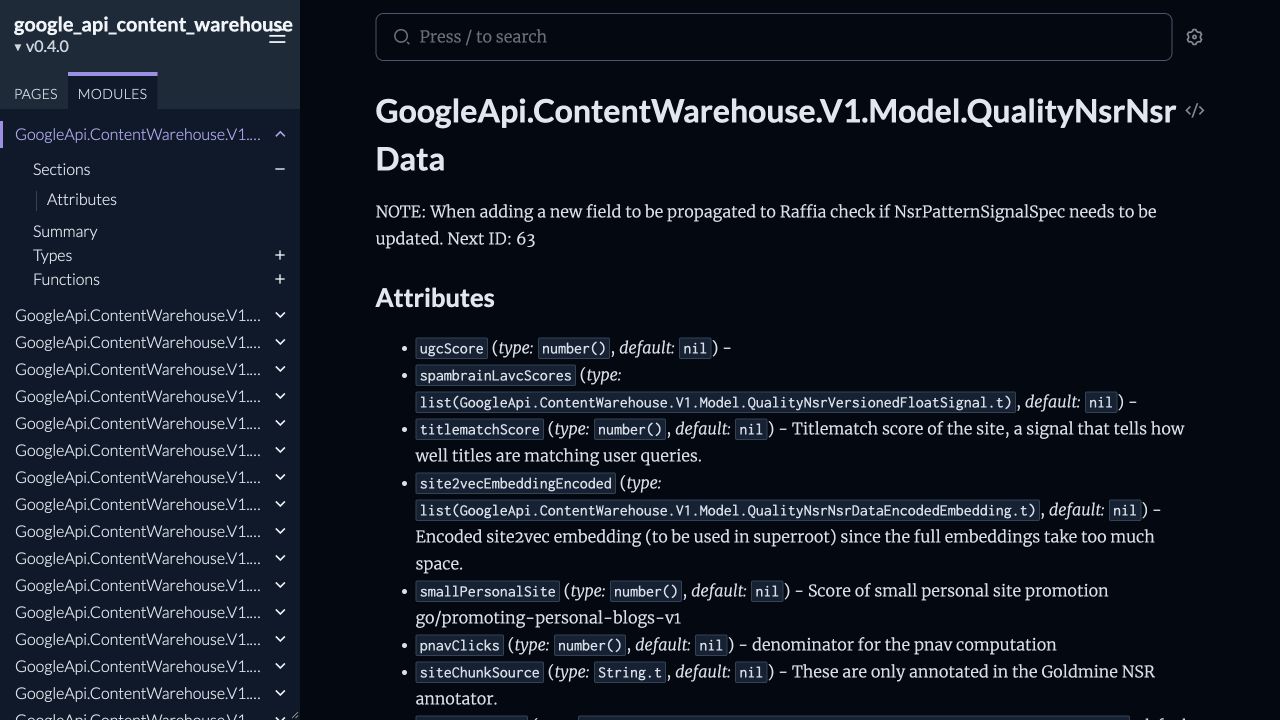
The documents exposed in 2024 describe Content Warehouse API data structures. The definitions here come from google_api_content_warehouse version 0.4.0, published on 28 March 2024. This is field documentation, rather than the ranking code that calculates which result appears first. Calling it an “algorithm leak” can set an expectation the material does not meet.
On 29 May 2024, Mia Sato reported in The Verge that Google had confirmed the documents were authentic. Spokesperson Davis Thompson cautioned against incorrect assumptions drawn from information that lacked context, was outdated or was incomplete. Authenticity does not establish that every field is used in ranking.
A name and definition can show which data was documented and how it was described. Alone, they do not reveal its weight, the conditions of its use or whether it is active today. When a definition names a use, we can report what it says while keeping the historical description separate from today's system.
The inspiration for reading the documents alongside Google's guide comes from Shaun Anderson's Hobo article. It annotates the guide with field names and acknowledges that the mappings involve interpretation and that the schema does not expose executing code or weights. This article compares individual claims with their supporting sources to decide what they mean for a team's work.
Four kinds of evidence: guidance, fields, findings and interpretation
Separate four kinds of evidence. This is not a universal reliability ranking: official guidance can explain what Google recommends to site owners, while a court finding can describe an internal system during the period examined. Each answers a different question.
- Official Google guidance: what the company tells site owners to do, such as how to write a title. Advice is not a measurement of its effect on your site.
- An API field: what exists in a particular version and how it is defined. Existence alone does not prove use in ranking.
- Testimony or a court finding: what a witness described and what the court accepted. State the year and paragraph; a historical description is not a present-day weight.
- SEO interpretation or experiment: what an author infers or reports under particular conditions. Separate the outcome from the proposed explanation.
For example, Google's Starter Guide explains useful titles. Paragraph 96 of the 5 August 2024 opinion describes Navboost's use of click data. One source supplies working guidance; the other supports a statement about a system during the period covered by the trial.
Eight leak claims, compared with their sources
Topic selection started with the Hebrew articles documented on page one of the Israeli search for “דליפת גוגל SEO” on 13 October 2026 and the Rand Fishkin analysis they cite. The sandbox claim has a direct source here: Mike King’s analysis. Effort was added because of Hobo. This is not a survey of everything written about the leak, and the claim labels summarize the readings rather than quote them.
Each row quotes the original English definition and explains its scope. The action column contains recommendations, not Google documentation. An empty evidence category means no such finding is supplied here, not that none exists. Scroll the table horizontally on desktop; on phones, each claim appears as a separate card.
| The claim | Original field definition | Testimony or court finding | What Google has said | What follows | What the claim misses | Team action |
|---|---|---|---|---|---|---|
| Clicks determine rankings | lastLongestClicks: The number of clicks that were last and longest in related user queries. This counts clicks described as last and longest in related queries; it does not explain how length is measured here. goodClicks and badClicks have no description in this version. Original definition | Court opinion of August 2024, on the 2023 trial record, paragraph 96 describes Navboost pairing queries and documents by memorizing click data. | How Search Works describes aggregated, anonymized interaction data used to assess relevance. | There is evidence of click data being used in a ranking system. Its current weight is unknown. | This does not establish page CTR as an independent lever or equate these fields with GA4 metrics. | Check that titles and snippets match the query and the content. Do not commission a click campaign on the strength of field names. See the worked example below. |
| Chrome data ranks pages | chromeInTotal: Site-level Chrome views. The definition refers to Chrome views at site level. Original definition | No court finding about this field is included in the sources reviewed. | Mueller, 7 January 2022, 12:52 said he did not think Chrome data was used for ranking, then qualified this by referring to CrUX data used for the page-experience report. | A field describing site-level Chrome views exists. | The definition does not explain a ranking use or identify the field with CrUX. The field and statement alone do not establish a contradiction. | On its own, the field creates no SEO task. A proposed priority change still needs an explanation connecting the data to the action. |
| Google has a site authority score | siteAuthority: site_authority: converted from quality_nsr.SiteAuthority, applied in Qstar. The description says the value is converted from another field and applied in Qstar; it does not give the calculation. Original definition | No court finding about this field is included in the sources reviewed. | Gary Illyes, 27 October 2016 said Google did not really have overall domain authority. | The field exists, and its name and description refer to site authority. | There is no shared definition equating it with the phrase in the post, Moz DA or Ahrefs DR. Inputs and weight are not supplied. | Do not set a DA or DR target as though it directly changes this Google field. For each task, I would ask what benefit it offers and how it connects to the data. |
| There is a score for how titles match queries | titlematchScore: Titlematch score of the site, a signal that tells how well titles are matching user queries. This is described as a site-level score relating titles to queries. Original definition | No court finding about this field is included in the sources reviewed. | Related guidance, not a statement about this field. The Starter Guide recommends clear, concise, distinctive and accurate titles. | The definition describes title matching at site level. | The definition is site-level, but does not explain how the match is measured or weighted. On its own, it cannot establish a rule for writing an individual page’s title. | Write a title that accurately explains the page. An awkward exact-query phrase is not justified by this definition. |
| Small sites are penalized | smallPersonalSite: Score of small personal site promotion go/promoting-personal-blogs-v1 The description refers to promotion of small personal sites. Original definition | No court finding about this field is included in the sources reviewed. | No separate public Google statement about this field is included. | The description says promotion, not punishment. | A Hebrew roundup uses the language of a penalty. That differs from the quoted definition; the opposite claim, that every small site benefits today, is also unproven. SEO Israel explicitly cautions that it is unclear whether the field affects rankings. | Do not change the size of a site because of this claim. Request the original definition and correct the wording in the proposal. |
| Google analyzes only a page’s last 20 changes when assessing links | urlHistory: Url change history for this doc (see crawler/changerate/changerate.proto for details). Note if a doc has more than 20 changes, we only keep the last 20 changes here to avoid adding to much data in its docjoin. This limits the changes kept here in a crawl-history record to reduce its size. Original definition | No court finding about this field is included in the sources reviewed. | Related guidance, not a statement about this field. Helpful-content guidance warns against changing dates without substantive content changes. | The text describes storage of up to 20 changes in this particular record. | The word here matters: this is not stated to be all the history Google retains or a limit on ranking or link analysis. | Update content when there is something to correct or add. Do not cycle through 20 edits or change dates to try to erase history. |
| The leak proves there is a sandbox | hostAge: The earliest firstseen date of all pages in this host/domain. These data are used in twiddler to sandbox fresh spam in serving time.Rest of definition: storage, dates and sentinel values It is 16 bit and the time is day number after 2005-12-31, and all the previous time are set to 0. If this url's host_age == domain_age, then omit domain_age Please use //spam/content/siteage-util.h to convert the day between epoch second. Regarding usage of Sentinel values: We would like to check if a value exists in scoring bundle while using in Ranklab AST. For this having a sentinel value will help us know if the field exists or has a sentinel value (in the case it does not exist). 16-bit | No court finding about this field is included in the sources reviewed. | Mueller, 23 February 2018, 25:38 rejected the traditional sandbox discussed by SEOs, while noting that algorithms assessing a site may look similar. | The description refers to fresh spam. | King concludes that there is a sandbox. But the definition limits its description to fresh spam; it does not establish a waiting period for every new site. | Do not assume a mandatory waiting period after launch. Investigate observable discovery, indexing and content problems. |
| Google scores effort, so we need to raise that score | contentEffort: LLM-based effort estimation for article pages (see landspeeder/4311817). It describes an LLM-based estimate of effort for article pages. Original definition | No court finding about this field is included in the sources reviewed. | Related guidance, not a statement about this field. Helpful-content guidance discusses effort as a criterion for quality raters and says raters do not control page rankings. | An automated estimate is described. Separately, human raters receive guidance. | A shared word does not prove a shared mechanism. No formula, weight or way to measure this field on your site is provided. | Invest in something readers can use and inspect: an explanation, comparison, a figure or a tool. In my view, hours spent and word count are not ranking targets that can be inferred from this field. |
Promotion or penalty: one word changes the reading

Dates need the same distinction. The 20-change limit belongs to urlHistory. The separate lastSignificantUpdate field says: Last significant update of the document. This is sourced from the quality_timebased.LastSignificantUpdate proto as computed by the LSUSelector from various signals. The value is a UNIX timestamp in seconds. In other words, a significant-update timestamp is computed from several signals. Neither definition proposes erasing ranking history through repeated edits.
Does Google rank by clicks? From the claim to a team decision
Start with Google's own explanation
How Search Works says Google uses aggregated, anonymized interaction data to assess relevance and converts it into signals for machine-learned systems. It is therefore wrong to start from the assumption that behavioral data is never used. That explanation does not establish page CTR as an independent factor a site can raise to improve its ranking.
Then read the Navboost finding
In United States v. Google, ECF 1033, paragraph 96 describes Navboost pairing queries with documents by memorizing user click data. The finding says Navboost was trained on 18 months of user data before 2017 and on 13 months since. Paragraph 102 says LLM signals had not replaced Navboost and QBST in ranking.
These findings draw on the 2023 trial record and were published in August 2024. They support the use of click data in a ranking system, without measuring its weight today. They supply no formula for how many clicks to buy or which CTR would secure first place.
What do the field definitions add?
The QualityNavboostCrapsCrapsData model includes goodClicks and badClicks without descriptions, alongside the lastLongestClicks definition quoted in the ledger. The names are consistent with distinguishing clicks, but do not define a “good” click or its weight.
It is easy to conflate systems here. These sources do not identify the fields with GA4 bounce or engagement metrics. After discussing Chrome in the original 7 January 2022 video, Mueller was asked about Google Analytics and said its data was not used for ranking. That is a separate historical statement, not a definition of the Navboost fields.
Two public reports with different methods
Rand Fishkin's post of 1 May 2014 describes a test the previous evening: he asked followers to search and click a result. He reported a move from seventh to first in the US results he checked within roughly three hours, with 228 Google visits that day. In the other countries he checked, the page was between sixth and ninth. He cautioned that this did not establish causality and raised alternative explanations, including links or other signals. The post does not establish how long the effect lasted.
Bartosz Góralewicz's August 2015 report concerns bot-generated traffic. One test compared three subdomains with the same number of pages and similar but unique content. He reported sending approximately 190,000 Google visits to one in March and April 2015, with the other two serving as comparisons. He reported that rankings did not rise before Weebly removed the sites. Traffic appeared in Analytics, and searches for the test keywords appeared in Keyword Planner. There was a comparison group, but visibility in those reports does not reveal whether the ranking system accepted the clicks as a signal.
The reports describe different interventions in different years: a human audience responding to a request versus artificial traffic. They are not replications and cannot be counted as one vote for and one against. Neither tests today's search system. The court finding supports the use of click data; the reports illustrate why turning that fact into a promise of external control requires further evidence.
The team's decision
For the illustrative proposal, I would retain work on titles and snippets that accurately represent the page and remove the promised ranking gain from a click campaign. A title change is justified when it helps searchers understand what they will get, as the Starter Guide recommends. Its usefulness does not depend on an assumed Navboost weight.
I recommend against buying or manufacturing clicks to influence rankings. These sources do not substantiate the promised result, and Google's spam policies prohibit automated queries and other automated access to Google Search without express permission. Under that definition, a campaign in which bots search and click without permission falls within the provision. It does not explicitly mention paid human clickers; my recommendation against buying their clicks rests on the evidence discussed here, not on an explicit prohibition of that practice in this provision.
Record a title change and examine Search Console data by page, query, country and device. Keep the date and note other changes made at the same time. If CTR rises, report that observation, then check changes in position, query mix and the results page before attributing the cause.
What the leak does not change about Google's guide
The ledger gives no reason to pause work on discovery, indexing or useful content. If a page does not appear in search, start with the indexing diagnosis guide. For gaps in the claims and evidence on your own site, use the E-E-A-T audit guide. This article has a different job: evaluating claims you receive about Google.
Hebrew was not present in the Starter Guide's language selector when checked on 13 October 2026. The explanations here help readers work with those sources, and the links allow each conclusion to be checked against its basis.
Four questions before changing the roadmap
These are the four questions I would ask before changing the roadmap:
- Where does the claim come from? Request a link to the full sentence, date and version where relevant. A field-name screenshot does not replace its description.
- What kind of evidence is it? Distinguish a definition, public guidance, a court finding and an experiment. Write one sentence stating what the source supports and what remains missing.
- What does Google already recommend? Accurate titles and correcting outdated information can be justified without claiming a secret weight has been revealed.
- What will we measure? Decide whether the test concerns a technical defect, a reader completing a task, search performance or inquiries. Success in one does not automatically prove success in another.
Use the B2B keyword research guide to connect the check to customer questions. A leak-based proposal can be adopted, rejected or tested on a limited basis. The connection between the source, problem and action should determine the choice. If the team needs help reviewing a proposal and choosing tasks, SEO consulting is the next step.
Research, source comparison and writing used Claude and Codex assistance. Nir Levi authorized publication; his language and editorial review remain pending. The opening scenario is illustrative, and the public experiments are attributed to their authors.
Sources & further reading
- Google: SEO Starter Guide ↗
- Google: Creating helpful content ↗
- Mia Sato, The Verge: authenticity confirmation (29 May 2024) ↗
- Content Warehouse package 0.4.0 (28 March 2024) ↗
- United States v. Google, ECF 1033 (5 August 2024), paragraphs 96 and 102 ↗
- John Mueller: Google SEO office-hours, 7 January 2022 ↗
- Gary Illyes: domain authority post, 27 October 2016 ↗
- John Mueller: Google office-hours, 23 February 2018 ↗
- Google: How Search Works ↗
- Rand Fishkin: queries and clicks test (May 2014) ↗
- Bartosz Góralewicz: bot-traffic comparison (August 2015) ↗
- Shaun Anderson, Hobo: Starter Guide decoded (inspiration) ↗
- Mike King, iPullRank: sandbox interpretation ↗
- SEO Israel: title matching, page history and small-site qualification ↗
- SEO-Rush: Hebrew roundup discussed in the small-sites row ↗
How this article was created
- AI involvement
- AI-assisted drafting
- Recorded tools
- Claude, Codex
- Documented human contribution
- Editorial direction and publication approval. Nir’s language and editorial review remain pending.
- Last substantive update
- Translation
- AI-assisted translation