iGaming Digital PR Case Study: How 10 Editorial Links Accompanied 431% Organic Traffic Growth
An iGaming website reportedly increased its monthly organic traffic from 5,647 to 30,022 visits in three months.
TL;DR
- Digital Web Solutions reports ten earned editorial links and roughly 431% traffic growth.
- Two publisher pages demonstrate the entertainment and regional research angle.
- The public evidence does not establish how much growth the links caused.
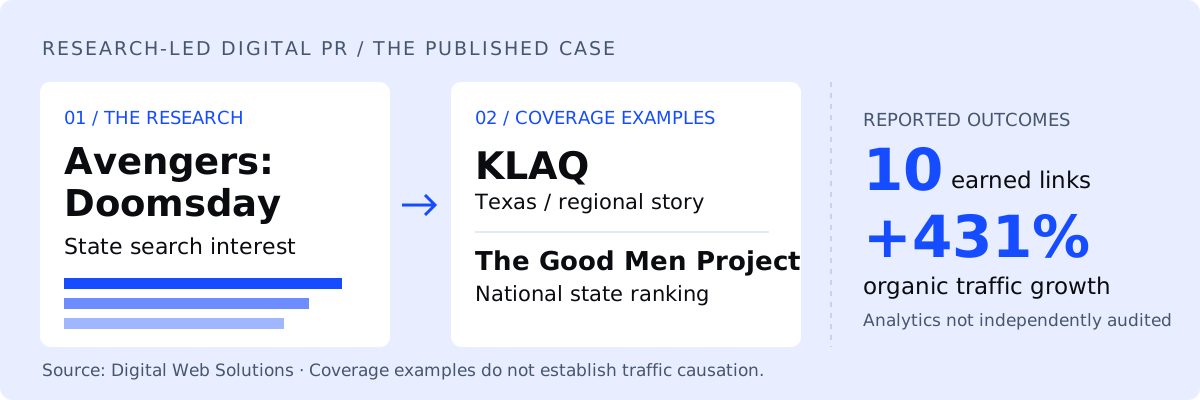
DoomsdayState search interest
Agency-reported outcomes
10 links+431% growth
The campaign at a glance
According to a case study published by Digital Web Solutions, the campaign generated ten earned editorial backlinks through data-driven digital PR.
That is approximately 431% growth, as reported by the agency.
But the most interesting part of this campaign isn't the percentage.
It's how a gambling-related website managed to get mainstream entertainment publications to cover its research.
Instead of pitching casino content, the team developed a study about Avengers: Doomsday, a major upcoming Marvel release at the time of the campaign.
The resulting articles were about entertainment and regional search interest—not casino bonuses or gambling products.
This case study examines how that strategy worked, what evidence is publicly available, and what I would take from it when developing an SEO campaign for a competitive iGaming website.
Reported monthly organic visits
+431% reported growth
The creative decision that changed the campaign
The team shifted its research away from the client's gambling products and toward subjects journalists might independently consider newsworthy.
One resulting study investigated which U.S. states were most interested in Avengers: Doomsday.
The topic combined recognizable entertainment news with geographical comparisons.
That gave national entertainment writers a broad story and regional reporters a local angle.
A journalist in Texas could focus on the state's ranking. A New York publication could focus on its first-place position.
Each angle emerged from the same research project.
The important distinction is that the research produced information useful to an editorial audience, rather than merely supplying a promotional reason to link to a casino.
The four-stage campaign
Find the story
Select a culturally relevant topic journalists are already covering.
Research the data
Collect search-volume estimates and normalize by state population.
Package for editors
Prepare local angles, concise findings, charts and the methodology.
Distribute and respond
Contact relevant journalists and support editorial requests.
Turning keyword research into a news story
The agency reports using Google Keyword Planner to analyze related search demand across all 50 U.S. states.
Raw monthly search volumes were normalized by population, producing a metric expressed as average monthly searches per 100,000 residents.
The calculation was:
Monthly searches per 100,000 = (estimated monthly search volume / population) × 100,000
The published study ranked New York first at 82.6 searches per 100,000 residents, followed by Nevada at 82.2 and Virginia at 81.8.
Texas ranked eighth with 77.5.
These findings gave publishers straightforward, locally relevant headlines.
However, the research still has limitations. Google Keyword Planner provides estimates rather than a count of individual searchers. Search interest is a proxy for enthusiasm, and differences in selected keywords or reporting periods can change the resulting rankings.
For any campaign I was evaluating, I would expect a clear methodology and access to the underlying dataset.
State search-interest ranking
Average monthly searches per 100,000 residents · Published 2025 study
- New York82.6
- Nevada82.2
- Virginia81.8
- Arizona79.2
- Georgia78.7
- Maryland77.9
- New Jersey77.8
- Texas77.5
- California76.8
- Utah76.7
Reported national average 63.9
The distribution strategy
Digital Web Solutions reports building a targeted contact list of more than 5,000 journalists.
The outreach was segmented by geography, publication type and editorial relevance.
The campaign also involved follow-ups and additional editorial support for journalists who requested information.
The agency's published process describes an initial email followed by outreach on days three, five and seven.
This operational detail is important.
It shows that the campaign wasn't simply a press release distributed to a few publications.
It involved research, content preparation, journalist discovery, segmentation and ongoing communication.
The final ten links were only one visible output of that work.
What was actually published?
Two verifiable articles demonstrate the campaign's editorial mechanism.
KLAQ published its Texas-focused article on April 3, 2025, discussing the state's position in the Avengers search-interest ranking.
The Good Men Project followed on April 11, 2025, publishing the broader national findings.
Both attributed the underlying research to Casino Zonder Registratie, a casino-information website.
Digital Web Solutions directly links these articles as campaign coverage examples. However, its case study does not disclose the client identity, so the full relationship between the named research source and the anonymous client cannot be independently confirmed from the public report alone.
The publications nevertheless demonstrate how the study was packaged for distinct audiences.
Two inspectable coverage examples
Texas in the top ten for Avengers search interest
The article reports Texas’s eighth-place ranking and credits Casino Zonder Registratie.
Read the published coverage ↗The national findings and ten-state ranking
The article presents the top ten and credits the same research source.
Read the published research ↗Ten backlinks and 431% growth: what does the evidence establish?
The agency reports ten earned links: eight from websites with Ahrefs Domain Rating scores between 50 and 60, and two from domains rated above 70.
During the reported three-month period, monthly organic traffic increased from 5,647 to 30,022.
These are meaningful reported outcomes, but they raise an important measurement question.
How much of the organic growth came specifically from those ten links?
The public report does not provide enough independently auditable information to answer that precisely.
I would want to review Search Console data, actual organic sessions, ranking changes, backlink acquisition dates, landing-page performance and other website changes during the same period.
It would also be necessary to separate branded and non-branded search growth, and determine whether the increase occurred on the client's commercially important pages.
A campaign can coincide with substantial organic growth without being the only cause.
The evidence supports the reported association between the digital PR campaign and traffic growth. It does not isolate the causal contribution of each link.
Ten reported editorial links
8 Links from DR 50–60 domains
2 Links from DR 70+ domains
Why I find this strategy interesting
The most important difference between this approach and conventional link acquisition is where the process begins.
Traditional link building often begins with a target URL and a desired backlink.
Data-driven digital PR begins with a question that a publication's audience might genuinely want answered.
The research becomes the asset.
A well-developed research asset can potentially generate editorial references, branded mentions, referral traffic and recurring interest after the original outreach finishes.
But I would not assume that every high-authority link has equal SEO value.
Editorial context, relevance, placement, discovery and the existing strength of the destination website all matter.
Domain Rating alone is not evidence of ranking impact. DR is an Ahrefs metric, not a Google ranking factor.
How I would apply this strategy to an iGaming brand
I would begin by identifying research opportunities that sit between the brand's area of expertise and subjects mainstream publications are interested in covering.
Sports fandom, entertainment, travel behavior and regional consumer trends could all be candidates, depending on the brand and available data.
I would then evaluate whether the research can produce a genuinely useful finding rather than a predetermined marketing headline.
The next step would be creating an authoritative research landing page containing the source data, methodology, charts, limitations and contact details. This is where a coherent content strategy matters: the resource needs to answer a real editorial question.
Only after the research is validated would I build the journalist list.
Regional findings would go to regional publications. Industry-specific findings would go to specialist writers. National conclusions would go to broader editorial audiences.
I would measure the campaign against more than a backlink target.
Useful outcomes include published coverage, qualified links, brand citations, referral visits, changes in non-branded organic visibility, and performance on strategically important landing pages.
This approach also needs a compliance review. An entertainment-focused story doesn't automatically eliminate the legal or policy considerations associated with a gambling-related sponsor.
Does digital PR help with GEO and AI citations?
There is a related opportunity in AI search.
When a publisher attributes a specific research finding to a brand, the article creates a public connection between the brand and that finding.
AI search systems may retrieve and summarize those sources.
But a link or mention doesn't guarantee inclusion in an AI-generated answer.
I would evaluate this separately by testing whether ChatGPT, Google AI Overviews and other relevant search experiences identify and accurately attribute the study when answering related questions.
For GEO and AEO, the opportunity is to create verifiable, well-attributed information worth referencing—not simply to increase mention counts.
The main takeaway
This campaign is a useful example of approaching SEO link acquisition through editorial value rather than placement volume.
The reported growth is impressive, and the public coverage provides evidence that the research reached mainstream publications.
What remains unverified is the exact contribution of those links to the client's organic traffic increase.
For me, the lesson is not that ten links will outperform hundreds of guest posts in every market.
It's that a research asset capable of earning genuine editorial attention can be more valuable than content created solely to justify a backlink.
Don't start by asking where you can place a link. Start by asking what information your brand can contribute that another publication has a legitimate reason to cite.
To judge where research-led PR fits into your site's wider plan, start with the baseline, commercial pages and measurement gaps. SEO consulting can help your team prioritize that work.
Sources and disclosure
This is an independent analysis prepared for Nir Levi. The campaign was executed and reported by Digital Web Solutions, not Nir Levi. The underlying client analytics and complete backlink portfolio were not independently audited. AI assisted drafting, source checks and visual integration; Nir Levi approved publication on 14 October 2026.
Sources & further reading
How this article was created
- AI involvement
- AI-assisted drafting
- Recorded tools
- ChatGPT, Codex
- Documented human contribution
- Nir Levi directed the presentation and approved publication on 14 October 2026. The underlying client analytics and complete backlink portfolio were not independently audited.